Monday, January 15, 2007

MAS Proposes Plan, Clashes Erupt in Cochabamba

On Wednesday Bolivia's government agreed to opposition demands that any changes to the country's constitution must pass with two-thirds support in the Constituent Assembly.

President Morales proposed a compromise plan that would permit any articles not decided by a two-thirds majority before a July 2 deadline, to be passed by a simple majority.

The work of the assembly had been deadlocked for months as political parties debated whether each element of the charter required a two-thirds vote. While President Morales supported constitutional amendments passed by a simple majority, four of Bolivia's nine states vowed not to recognize a constitution written in such a manner.

Opposition leaders organized protest marches and hunger strikes demanding that Morales approve a two-thirds vote for each individual article. They claimed that Morales sought to freeze them out of the new constitution with the opposition stronghold resting in the eastern department of Santa Cruz. Last month, hundreds of thousands marched through the streets of Santa Cruz de la Sierra demonstrating for the two-thirds vote.

This is a major concession for Morales and his political allies. Yet opposition parties do not support the new proposal and claimed MAS will actively stall any progress until the July deadline. The Constituent Assembly has been in session since August but its work remained at a standstill. This latest attempt to move along the constitutional process may be derailed if these factions are unable to reach agreement.

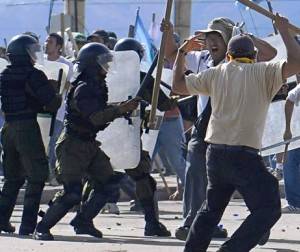
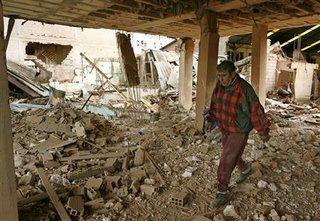
Meanwhile in Cochabamba supporters of President Morales clashed with supporters of provincial governor Manfred Reyes Villa last week, leaving two dead and at least 130 injured in the city of Cochabamba.

Tension grew as protesters blocked roads to the city for three days in an attempt to remove the governor. Fighting erupted on Thursday when Reyes Villa's sympathizers entered the city with reports indicating that armed supporters of the governor attacked the coca farmers.
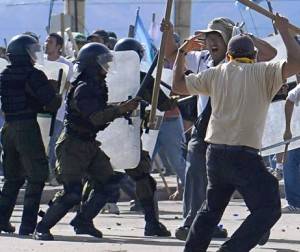

The first casualty was Nicomedes Gutierrez a coca farmer. Cristian Urresty Ferrel, a student and member of the Young Democrats, a group supporting Reyes, was also killed during the violent clashes.

According to Bolivian military officials, an estimated 30,000 demonstrators from these two rival factions overran police in the streets of Cochabamba, armed with sticks and rocks. This is the latest event in a month of protests that filled the city’s streets.

Supporters of the national government have called for Reyes’ resignation amid accusations of corruption, including bookkeeping irregularities and using state funds to reward rural towns that support opponents of Morales.


In defiance of the central governemnt, Villa Reyes and five other provincial governors joined together to demand greater independence. He has called for Cochabamba to hold a second vote on the autonomy referendum - a measure that was voted down by 63 percent of Cochabambans in July of last year. The Cochabamban governor has also sided with opposition leaders who said each of the new charter's articles should be written by two-thirds of the assembly's delegates and publicly denounced Morales' handling of the rewriting Bolivia's constitution.
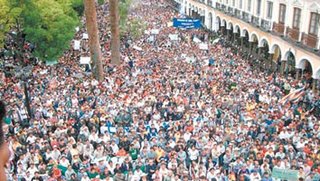
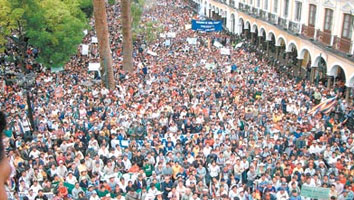
National and regional leaders blamed each other for the political violence. A senator supporting Morales placed responsibility for the two protestors’ deaths with Reyes, while six opposition governors joined in blaming President Morales. Tarija’s governor Mario Cossío and Luis Paredes, governor of Santa Cruz, insisted that Morales restore order in the region.

Authorities have said a force of 1,500 soldiers has been dispatched to Cochabamba, which is 125 miles southeast of La Paz.

Vice President Garcia Linera described the action of Villas’ supporters as "a provocation" and criticized Reyes for failing to “exercise control and resolve conflicts in a peaceful manner.” Last week Morales dismissed Cochabamba’s chief of police after he directed officers to fire tear gas on peaceful protestors.

Reyes’ opponents have called for a dialogue but most believe that the time has come for him to relinquish his position. He has refused to step down, stating he had no reason to resign.

However claiming to fear for his safety, Reyes fled to Santa Cruz after meeting with other opposition governors in La Paz. Hundreds of pro-Morales protesters surrounded the La Paz hotel where the governors were meeting.

President Morales, a native of Cochabamba, has called for Reyes to return to his state. Reyes Villa is one of the first elected Bolivian governors. Prior to 2005, the nine department governors were appointed by the president.


Labels:

Sunday, January 07, 2007

Promises Kept, Pendulum Continues Swing Left

President Morales ended 2006 by holding his last Cabinet session at 11:30 pm on December 31st. The session continued into the morning of January 1 when at dawn, Morales and his ministers announced the creation of new social and economic programs.

Morales issued five new executive orders, including the Universal Health Law that will give “universal, complete and free” health care to people under the age of twenty-one. The project, which is to be financed with money from gas sales to Brazil and Argentina, will have the impact of insuring 75 percent of Bolivia’s population and will also provide scholarships to young Bolivian doctors.

In a move to further Bolivia’s economic progress, the Bank of Desarrollo Productivo (BDP) was created by decree on January 1. This Productive Development bank is funded with $60 million to support smaller producers and entrepreneurs by loaning seed money with low and long-term interest rates.


Further fulfilling a campaign promise to ensure greater respect for indigenous rights, President Morales also approved a measure integrating community justice systems in indigenous communities with the judicial system of the Bolivian state. This is one of several efforts Morales has made over the past year to eliminate institutional discrimination against Bolivia’s indigenous majority.

The year 2007 begins with clear evidence of Latin America’s ideological swing to the left. January is a busy month for Morales who is expected to take part in the ceremony of Nicaraguan President-elect Daniel Ortega, attend the inauguration of Ecuador’s Rafael Correa and also Hugo Chavez’s taking of office ceremony.

Undoubtedly all eyes will be on the MERCOSUR summit in Rio de Janeiro on January 18 and 19 that will give further indication as to whether Latin America’s movement towards socialism will become a wider regional effort.

Almost a year into his presidency, Morales continues to field criticism from political conservatives and business interests yet he presses on with the platform that he was elected on: bringing justice to Bolivia’s indigenous majority by sharing the nation’s wealth and political power.

Labels:

Saturday, December 23, 2006

The Rich, The Mad, & The Angry

Leaders of Bolivia's richest provinces planned massive street protests on Friday to demand greater autonomy from the central government and more control of local taxes. Demonstrations took place in Santa Cruz, the southern city of Tarija and in Bolivia’s Amazonian northeast at Trinidad.
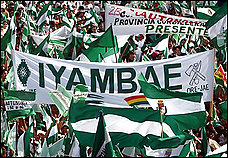
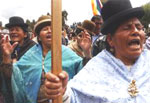

Protesters and their rivals hurled rocks at each other in San Julian, a town about 70 miles northwest of Santa Cruz, injuring more than 20 people.
Demands for autonomy in Santa Cruz, Beni, Pando and natural gas-rich Tarija -- four of Bolivia's nine regions -- have dogged President Morales since he took office in January.

The movement, which predates the Morales administration, has taken on fresh urgency amid a bitter fight over the president’s control of an assembly rewriting the Constitution.

Convened in August in the former colonial capital of Sucre, 250 miles south of La Paz, the Constituent Assembly has been given a year to write a new constitution. But after four months, the body has yet to write a single word.
Morales' Movement Toward Socialism party controls just over half of the popularly elected assembly rewriting the constitution, and the president says its simple majority is enough to approve individual articles in the document.

The conservative opposition, centered in Santa Cruz, Bolivia's largest and most prosperous city, says each of the hundreds of articles require a two-thirds vote, granting them more say in the new document but likely slowing its writing to a crawl.

The problem is the assembly's own vague bylaws, which state only that delegates ``approve the text of the new constitution by two-thirds' vote'' before it goes to voters for final approval.

Santa Cruz is an opposition stronghold and many of its people feel they have little in common with the poor west of the country, where Morales has his support base. While denying any intention to secede, the opposition insists that the assembly bylaws require the document to be written by two-thirds of the assembly.

Meanwhile Morales argues that the rule means that only the constitution's final draft need pass by a two-thirds vote - and should it fail, the president has said he'll put the framework to a nationwide referendum anyway.
The opposition says the president’s backers have frozen them out of the writing of the new charter, and protest leaders decried what they see as Morales’ exclusionary tactics.

The mestizo and white middle and upper classes fear Morales aims to shut them out of the reform process and risk Bolivia's hard-won economic stability with socialist policies but these opponents of President Morales denied wanting a breakaway state.

Opposition to some Morales policies, such as his plan to redistribute idle farmland to peasants, is stronger in the east, while the western provinces, largely populated by Aymara and Quechua Indians, strongly support his policies.

Bolivia is roughly divided along ethnic and economic lines, with the resource-rich eastern lowlands home to more European-descended people, while the indigenous majority, who are relatively poorer, populate the western Andean plateau.

Morales dismisses the complaints of his opponents, saying that it is high time the poor majority of the country begins to take power from the rich minority.

``We've begun to take back Bolivia,'' Morales said, directing strong words at the business elite leading the autonomy movement. ``Now that they can't sell Bolivia, they want to divide Bolivia, that's the basic issue. There will be no division.''

While acknowledging the protesters' right to march, Morales said earlier that any move by the eastern states to declare independence would provoke a military response.

Labels:

Monday, July 03, 2006

Two Sides of the Same Coin

On July 2nd Bolivians voted for a new Constituent Assembly of 255 national delegate representatives. President Evo Morales’ Movimento al Socialismo party took 134 seats – the most of any Bolivian party - but not enough to have the two-thirds majority needed to guarantee MAS-supported reforms.

MAS acquired 53% of the Constituent Assembly seats with the Podemos party taking the second highest percentage - a distant 23.5%.

The assembly will be installed in the city of Sucre on August 6 to begin deliberations that will rewrite Bolivia's constitution within the next six months to a year. The new draft constitution will then be presented to the Bolivian electorate for their approval.

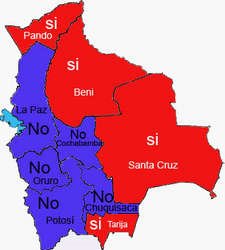
Also on the ballot was a referendum to permit more autonomy to the nine regional departments of the country. Power has long been centralized in La Paz and the autonomy movement wants greater fiscal and political independence within individual regions of the country.

Four of the nine departments - Santa Cruz, Tarija, Pando and Beni - voted for the autonomy referendum. These states are all rich in the country's natural resources - possessing as much as 90 percent of the nation's natural gas reserves.

Exit polls show that voters in Santa Cruz - Bolivia's wealthiest and largest state - approved autonomy by 78 per cent.

Morales supported a "No" vote on the referendum, which according to some analysts could put him on a collision course with the powerful pro-autonomy lobby of Santa Cruz province.

The autonomy vote may exacerbate longstanding tensions between the wealthier eastern lowlands and the poorer, less fertile Andean highlands. One commentator spoke of resentment among the residents of the Santa Cruz. They resent Morales' efforts to “siphon” money from their region to empower the long-neglected indigenous majority and exert greater state control over the economy.

The autonomy question is expected to be at the top of the Constituent Assembly’s agenda along with proposals to replace Bolivia's current congress with a more representative body and elevate indigenous languages to the same legal status as Spanish.

MAS reforms also include redistributing economic and political power to grant Bolivia's majority indigenous population a greater share of the country's wealth, strengthen the traditional indigenous justice system and end years of corrupt government by a wealthy elite.

Morales recognized that four of the five provinces voted for autonomy and stressed that the Constituent should respect that result and debate the autonomy demands of small jurisdictions and indigenous peoples.

Without a two-thirds majority MAS may have to forge alliances with other political parties in order to realize its reforms at a time when the Morales administration is drawing fire from opponents that criticize his close ties to Venezuela and Cuba, nationalization of Bolivia’s hydrocarbons and the fast pace of change within the country.

There have been 18 constitutional reforms that have arisen from constituent assemblies and conventions in Bolivia. Experts estimate that the ones achieved in 1825, 1826, 1938 and 1967 stand as the most important.

Labels:

Sunday, April 16, 2006

Nationalization Delayed, Bolivia Takes Smaller Steps on Hydrocarbons

The much anticipated plan for nationalizing hydrocarbons will be delayed “some weeks” according to Alex Contreras, spokesman for President Evo Morales. This statement follows an announcement last week that the Bolivian government will not nationalize Andina, a local subsidiary of Spanish energy

giant Repsol.

Both represent major obstacles in the country’s aim to nationalize its oil and gas reserves. Elected on a platform that promised nationalization of the country’s resources, the new government is taking a number of different tactics to reach that goal.

In late March the Bolivian government filed charges against three former presidents, eight former energy ministers, and arrested two business executives - all in conjunction with inappropriate oil and gas dealings.

Former presidents Carlos Mesa, Gonzalo Sanchez de Lozada, and Jorge Quiroga are charged with violating the country’s constitution by signing lucrative contracts without congressional approval.

Bolivian Attorney General Pedro Gareca announced his discovery of 44 illegal contracts signed by the former presidents with foreign oil firms between 1993 and 2003.

In addition, last month’s arrest of Julio Gavito and Pedro Sanchez has put increased pressure on multinational companies operating in Bolivia.

The two Repsol executives - who were each released on $50,000 bail - face charges that their company smuggled $9.22 million worth of oil between 2004 and 2005. Gavito - president of Bolivia’s state-run Yacimientos Petroliferos Fiscales Bolivieros (YPFB) and also Vice President of Andina - recently resigned claiming “personal reasons”. Sanchez will remain as the Chief Operating Officer of Repsol YPF Bolivia. If convicted they are facing charges of three to six years.

Beyond the legal pinch, multinationals are feeling an economic squeeze as the Morales government demands back taxes as well as higher royalties.

Last week the Bolivian government announced a claim of $40 million in back taxes from oil and gas companies that are currently doing business in Bolivia. The amount could be worth as much as $200 million if penalties and administrative fees are calculated. Multinationals have appealed the decision to Bolivia’s Supreme Court.

This is the latest tool to be used as the government moves to renegotiate oil and gas contracts with companies from Europe and Latin America.

In late March, France's Total SA announced that it will pay an increased tax on oil exports from Bolivia. The new tax levy will increase royalties from 34 percent to 50 percent. Total SA also announced it had established a partnership to develop new gas fields with YPFB.

In contrast Petroleo Brasilerio SA chief executive Sergio Gabrielli declared that the company's future in Bolivia is uncertain. This amid recent demands that Brazil pay increased prices for natural gas.

Gabrielli's comment was prompted by disagreement with Bolivia’s hydrocarbon plans as well as statements made by Bolivian Hydrocarbons Minister Andres Soliz.

Soliz has accused Brazil of taking a tough stance on renegotiating gas purchases and exerting geopolitical pressure on the nation. In February Petrobras presented the new government with an investment plan worth US$5 billion. It has since declared a halt on all future investment.

Petrobras has invested over US$1.5 billion in Bolivia since 1996. Foreign oil and gas companies such as Britian’s BG and BP, Spanish-Argentine Repsol YFP SA, France's Total SA and U.S.’s Exxon Mobil Corporation have invested $3.5 billion in Bolivia since privatization was implemented in the 1990’s.

But many Bolivians will not be happy until multi-nationals are taken over by the government or expelled. Bolivian labor leader Felix Muruchi states that many residents in the poor city of El Alto want to see full nationalization of the nation’s resources that includes kicking out the multi-national corporations.

Last week Morales formally announced that Bolivia will not nationalize Repsol's local subsidiary, Andina. The cash-strapped government is not willing to assume a $57 million debt in order to take over the company. According to Soliz, Andina's debts reach a total of $177 million although its book value is only $120 million.

The new government must also contend with past contracts like those that put Brazil's Petrobras in control of 95% of Bolivia’s refining capacity. Brazil also owns a pipeline as well as 25% of the Bolivia's gas stations.

These type of arrangements represent some of the disproportinate influence that multinational companies have had in a country that is rich in natural resources but poor in economic development.

Planning Minister Carlos Villegas has stated “It’ll be a gradual process. We don’t want extreme or abrupt measures, or shocks which only generate uncertainty”.

Last week’s announcements demonstrate that the ability to "dismantle colonialism and neoliberalism" may be easier in theory than in practice.

Nationalization has been identified as a key issue that could drive a wedge between Morales and his MAS supporters. Critics of Morales contend that his government has yet to show how nationalization will work.

Yet his administration appears willing to use both economic and judicial methods as it moves towards the nationalization of all the country's hydrocarbons by July 12.

Labels:

Wednesday, March 22, 2006

grey-eyed man of destiny

To what extent will the United States interfere with the political climate in Bolivia? We beg that question following recent acts of terrorism in the capital city of La Paz.

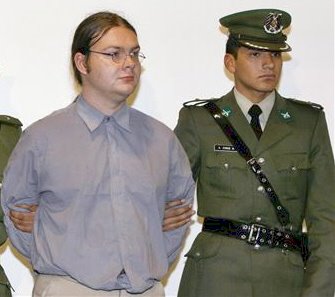
Early Wednesday morning (3.22.06) two hotels in La Paz were rocked by explosions that left two dead and four wounded. An American man and a Uruguayan woman were arrested in connection with the explosions.

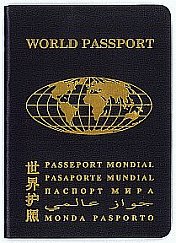
One of the blasts was caused by C4 – a highly powerful explosive. According to La Razon, the C4 may be of Israeli origin. Early reports have proven true that the couple was using non-government issue passports for entry & exit to most countries.

The story has already inspired vast amounts of coverage in international and national media, with many headlining the arrest of an American perpetrator who calls himself "Lestat Claudius de Orleans y Montevideo" (aka Triston Jay Amero).

The facts of the case are still forthcoming, yet the available information points to the possibility of persons known in some form by the United States' various intelligence services.

Although Bolivians are zealous activists - even to the point of blockading roads and disrupting the flow of goods and services - random violence of this sort has not historically occurred within the country.

Bolivia is far removed from Arab interests and Muslim-sponsored terrorism as less than o.o1% of Bolivians are followers of Islam, while modern narco-terrorism is limited mostly to Colombia.

By examining the preliminary information and looking at the political history of the country, it is highly suspect that this terrorist act was executed without the working knowledge of an international organization like the Central Intelligence Agency. The U.S. intelligence community should have known of an American - who has vocally renounced his citizenship - using a quasi-legal passport to enter countries under an assumed name while traveling with a military grade plastic explosive.

Since Evo Morales assumed the Presidency, the United States’ military interests in Bolivia have been severely jeopardized. One of Morales’ first acts as president, was to bypass 28 military commanders for promotion as his administration investigated the secret removal of shoulder-fired anti-aircraft missiles to the United States.

The missle scandal inspired the Bolivian Attorney General’s office to call for the indictment of former President Eduardo Rodriguez, the defense minister and supreme military commander on treason charges.

Morales’ new military appointments are not trusted by the Pentagon and in response the U.S. has demanded the return of sensitive arms and equipment provided to Bolivia’s counterterrorism force.

By resisting the Bush administration’s demand to grant U.S. officials and soldiers immunity from prosecution by the International Criminal Court, Bolivia lost 96% of its military aid from the United States.

Additionally the U.S. has declassified the country as an anti-terrorism partner. As such Bolivia’s anti-terrorism force will lose about $300,000 for U.S. sponsored training programs. It would seem after such an event, that reducing the funding to prevent terrorist attacks may prove to be a "penny wise & pound foolish".

Some local media have suggested that the latest events in La Paz may be a covert process of U.S. involvement in Bolivian politics.

In the least, it would seem most to indicate yet another U.S. Homeland Security failure to identify Mr. Amero's dubious travel documents & prevent his exit from the United States, possibly with high-grade explosives.

Bolivia had been enjoying a relative socio-political calm in the current political transition, an American disturbing that peace with terrorism, at the price of two lives is tragically ironic & should remain wholly unacceptable.

Labels:

Tuesday, February 28, 2006

Visible reforms improves Morales' mandate

Poll results reported in Bolivia’s La Razon reveal that Evo Morales' approval rating has risen five percentage points during his first month in office - climbing from 74 percent before he assumed the Presidency to its current level of 79 percent.

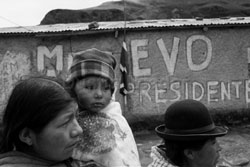
His government came to power on a platform that blasted the “neo-liberal” model of the West, vowed to end corruption, called for the nationalization of Bolivia’s natural resources and offered greater representation to indigenous people. And so far it seems to be working for a man serenaded in the streets of Bolivia with the cries of "EVO".

Initially Morales made some symbolic reforms that reflected a commitment to serve the interests of the country.

Morales cut his salary by half and also reduced the salaries of the vice-president and his cabinet members. Savings will be used for health and education programs. According to some reports those savings could be as high as $27 million. Other economic and political gains may come from fighting government and corporate corruption.

Establishing Greater Accountability

The new president eliminated three government sectors - taxes, customs and roads - that were recognized as corrupt and ineffective. And Morales' fight against corruption has cast a large spotlight on the Spanish-Argentinian oil company Repsol-YPF .

Repsol's problems with the new Bolivian government began earlier this month, when Morales ordered the creation of a special commission to investigate claims that the company seriously damaged the environment surrounding the Margarita gas field in Chaco. The commission will investigate Repsol's actions and determine the amount of compensation owed to indigenous communities in the region.

Additionally Morales called for the arrest of Julio Gavito, the chairman of Repsol’s Bolivian unit Andina SA. The Bolivian government is charging that the company smuggled more than 230,000 barrels of crude oil out of the country between 2004 and 2005, robbing the Bolivian people of $9 million. Repsol calls the incident a "misunderstanding".

Morales' sweep even extends beyond the nation's borders. He asked the United States to extradite former Bolivian president Gonzalo Sanchez de Lozada so that he can be tried for a massacre of protestors in February 2003 that left more than thirty people dead.

Morales is quoted as saying that Democratic governments have nothing to hide and “neither do they protect criminals”. Sanchez de Lozada fled to the United States in October 2003 after his presidency was toppled by protests.

Managing Hydrocarbons

Although change may not come fast enough for some vocal critics – namely those who are closely watching Morales’ emerging hydrocarbons policy - his government has made efforts to improve Bolivia’s economic gain from natural gas exports.

On February 21, the government approved a resolution to raise the price of natural gas exported to Brazil and Argentina. Currently Brazil pays Bolivia $3.23 per one million British Thermal Unit (BTU) of natural gas and Argentina pays $3.18 per one million BTU. The market rate is closer to US$10-12 per BTU and new prices have yet to be determined.

If predictions from International Monetary Fund Managing Director, Rodrigo Rato are correct, Morales will be able to ride the development wave of Bolivia’s natural gas resources all the way to the bank. Morales has been quoted as saying that he wants foreign investors to be partners, not owners, in developing the country's gas reserves.

According to Rato, if the Morales government aptly handles the development and expansion of its natural gas industry, Bolivia could see its Gross Domestic Product per capita double during his term in office. A healthy economy may be the only way to pacify those who are destined to lose political power as Morales moves forward on some of his reforms.

Granting Indigenous Rights

Morales’ greatest and most complex political reform is the formation of a Constituent Assembly. The Constituent Assembly will create a new arm of the government, thereby weakening the powers of the Executive and National Congress. It is a major step that Morales and his Movement to Socialism (MAS) party view as a means to grant greater representation to Bolivia's indigenous people.

Yet, the proposal in its present form is being met with substantial resistance. Some critics complain that it did not offer enough influence to each of the broad-range of groups that supported Morales’ presidential campaign. Morales anticipated that his proposal for choosing assembly members would not win enough support to pass through the National Congress in early March, thus jeopardizing the entire assembly process.

So Morales has dropped his current proposal even though it would have granted his MAS supporters an overwhelming majority in a Constituent Assembly. Now his administration must propose a new way to recognize more of his supporters but not undermine their overall goal. If there is one thing Morales has demonstrated thus far in this past month, it is the desire to honor his commitment to fairness and equality.

The poll results demonstrate that Morales' political savvy outweighs his signature fashion sense and fiery campaign speeches. In a country that has gone through five presidents in four years - two of whom were toppled in part by Morales’ demonstrations and leadership - he appears to understand the fragile balance that must be held in his country between political promises and political progress.

Labels:

Monday, February 20, 2006

Shaping Bolivia's Coca Policy

During this past week President Evo Morales continued to show his support for Bolivia’s cocaleros, yet publicly he also displayed a more centrist tone towards the United States' efforts to limit coca production within this South American nation.

In a move that some called unconstitutional, Morales maintained his close ties to the cocaleros by accepting another term as leader of the country’s main coca-growers union. This will be Morales’ sixth consecutive term at the head of an organization that he has led for the past 18 years. Critics within the country contend that the position represents a conflict of interest with the potential for bias.

Yet Morales’ most recent actions have been disappointing to many of his cocalero supporters as his attitude towards the U.S. has been less harsh than during his days as a presidential candidate.

After meeting with U.S. Ambassador David Greenlee this past weekend, Reuters reported that Morales spoke of reaching "a common ground" with the U.S. in a story that was widely circulated by national media sources.

Bolivia's La Razon noted that Morales and Greenlee met for almost two hours discussing areas of mutual interest such as the defense of the democracy and the fight against drugs, corruption & poverty. Both sources state that neither country reached any agreement on a policy of eradicating excess coca plants - a fact that Morales cited as a potential point of conflict with the United States since it maintains a policy of 'zero coca'.

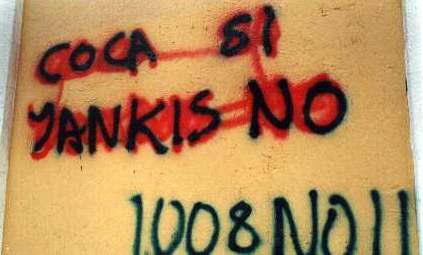
Since taking office Morales has stated that his policies will reflect "yes to coca, no to cocaine".

The Cocaleros and the U.S.

There is pressure upon Morales to increase the amount of coca that farmers are legally permitted to grow in Bolivia’s Chapare region, located in the cental part of the country. An agreement - unofficially recognized by the U.S.- was signed by former President Carlos Mesa in 2001.

The law permits families in this tropical region to grow no more than a cato of coca - approximately four-tenths of a acre. In the past growers have demanded an increase to the amount of coca that is permitted under Bolivian law.

Morales’ words to a group of cocaleros is Chapare last Saturday demonstrated that he was willing to limit coca production. He called for local farmers to adhere to the law. Morales suggested that obeying the law is the best way to support the government and get “the U.S. to stop talking badly about us.”

Claims issued by the U.S. government and the farmers in the Chapare region have long been contradictory. The U.S. states that most of the coca grown in the Chapare region is used for the illegal drug trade and cocaine production. Meanwhile poor farmers say coca is mostly used for traditional purposes as a natural hunger depressant and treatment against altitude sickness.

Some of these same cocalero voices also called for the deportion of the U.S. drug enforcement agents. However Morales declared that the U.S. can remain in Bolivia as long as the country’s laws and sovereignty were respected.

Bolivian troops assigned to eradicate coca fields halted their operations after Morales’s inauguration on January 22nd. The future role of the U.S. remains to be outlined by the current Bolivian government.

According to Jim Schultz of the Democracy Center, the U.S. views Bolivia as a "poster child” for its war on drugs and the U.S. government is reluctant to risk that progess. It credits eradication efforts undertaken since 1988 for taking Bolivia from the second largest coca producer to a distant third after Columbia and Peru.

Annually the U.S. spends more than $1 billion to fight cocaine in the Andean region. The U.S. State Department’s Andean Counterdrug Initiative includes Bolivia, Brazil, Ecuador, Panama, Peru and Venezuela and Colombia. Yet the U.S. remains the largest market for cocaine use, followed by Brazil.

Using the Coca Leaf

Currently the European Union is funding a study to determine the extent of coca's domestic and international markets. The study is scheduled to be completed in August of this year.

Officials in Morales’ administration believe there is a large Andean market for coca tea, known for its effectiveness against altitude sickness. Government officials are quoted as stating that they are currently looking towards countries like Argentina, India and China as potential consumers of coca products.

Morales announced plans to travel to India next month in order to obtain financial support from New Delhi for a project to make coca-based products and to secure funding for social programs.

Coca can be used in a number of consumer goods such as lotion, face cream, toothpaste, shampoo, soap and even flour. Its effectiveness as a stimulant and appetite suppressant has been known by indigenous people for centuries.

A Harvard study conducted in 1975 confirms that coca has beneficial properties. Researchers found that a 3.5 ounce coca leaf has 1,540 milligrams of calcium. The average glass of milk has 300 milligrams. The study also determined that coca contains protein, iron, phosphorus and vitamins A, B1, B2, E and C.

The findings provide some scientific support for comments made recently by newly appointed Foreign Minister David Choquehuanca. Dismissed by some as lunacy, Choquehuanca was quoted as saying that the “sacred leaf” is nutritious enough to be served in school breakfast.

For now Morales' supporters within the cocalero federation just want to secure the freedom to grow enough coca to provide for their families.

Labels:

Tuesday, February 07, 2006

U.S. Watches Bolivia for Coca, Little Else

If one is not characterizing the new government of Evo Morales as “radical”, punching holes in the support structure of his 12-day old administration or discussing coca production, the United States is showing very little personal interest in Bolivia.

One major indicator of the U.S. attitude towards Morales was President Bush’s belated congratulatory call on February 1st – ten days after Morales’ inauguration on January 22nd and a whole 45 days after he was elected in an overwhelming demonstration of Bolivian democracy.


Speaking at a National Press Club event last week, Secretary Donald Rumsfeld stated that “elections like Evo Morales in Bolivia take place that clearly are worrisome," as he lamented the left swing of Latin American politics.

More than 85% of eligible Bolivians turned out to vote Morales into office with a 54% majority. By contrast, in the U.S. the most recent 2004 Presidential election had a voter turnout of 60% with Bush losing the popular vote, but winning the election by the electoral college system.

Scanning the stories about Bolivia that are most readily featured in the U.S. media, the American corporate press has chosen to focus on Morales’ developing drug policy. Major media outlets from the Associated Press and CNN to local papers of North Carolina and Utah are highlighting Morales’ cocalero constituency and his appointment of Felipe Caceres, a "radical" and former coca farmer, as the country’s drug czar.

To move beyond Morales’ drug policy, one may need to search European, Latin American and Chinese news sources to find other initiatives that are moving forward in his country.

Bolivia is already working with Cuba to eliminate illiteracy in the country within two years. Venezuela’s Chavez has reached agreements to supply Bolivia with diesel and is offering technicians and scholarships to further Bolivian education. And although Venezuela had provided emergency aid to Bolivia last week, Chavez, who was just granted the UNESCO's 2005 Jose Marti International Prize, chose to donate the $5,000 award for additional relief efforts in Bolivia's flooded regions.

White House Spokesperson Scott McClellan failed to mention that President Bush extended our condolences for the recent loss of life caused by flooding throughout the country when he made that congratulatory call. He also neglected to mention whether the United States, the wealthiest nation in the world offered Bolivia - the poorest country in the Western hemisphere - any emergency aid.

Considering the lack of national or international press highlighting the charitable actions of the Bush administration, those words were probably never spoken.

Even while Bolivia is overcoming this national emergency, the country's aid from the U.S. does not remain secure. According to Bolivia’s La Razon, the Bush budget for 2007 removed another $13 million in aid. This is the second cut in funding Bolivia has received since the 2005 fiscal year. Critics of Morales, both here and abroad, blame Bolivia’s shift in drug policy for the loss of additional U.S. funds for drug enforcement. Some believe this is a tactic to pressure the Morales government into pushing a more American friendly coca policy.

Labels:

Thursday, February 02, 2006

Meeting the Challenges and Promises


Barely ten days into his Presidency and already the domestic and international diplomacy of Bolivia’s Evo Morales has been put to the test. It has been a challenging and ambitious beginning to this historic assumption of power as Morales signed agreements with Cuba and Venezuela as well as satisfied some of the campaign promises laid out by his Movement to Socialism party (MAS).

Challenges

Unexpected challenges arrived with persistent rains that caused heavy flooding in the regions of Beni, La Paz and Santa Cruz, resulting in thirteen deaths. Over the weekend rivers continued to overflow as thousands of acres in agricultural crops have been devastated.

More than 33,000 Bolivians have been affected as landslides and flood waters have destroyed homes, washed away roads and bridges.

Jose Luis Paredes, governor of the Department of La Paz, reported that $10 million USD would be required to meet disaster needs in his region. About 150,000 acres of soy crops were devastated in the eastern department of Santa Cruz as rivers continued to overflow.

Morales' issuance of Supreme Decree No. 28610 declared a national state of emergency and paved the way for Bolivia to appeal for international aid. Venezuela and Cuba were the first countries to offer assistance in the form of food and medical supplies.

Reports indicate that a Cuban Airlines plane left Havana on Wednesday morning carrying almost 16 tons of medicines, as well as tents.

Venezuela is donating 10 tons of supplies to Bolivia including imperishable goods, tools, drinking water, medicines and blankets, according to El Universal. In addition, the Chavez government has committed to sending doctors, engineers and experts in communications and disasters.

Bolivian news sources report that refugee camps have been set up in parts of the country where Bolivia's Civil Defense and armed forces provide the needy with tents, food and medical attention.

The UN Development Program reported an immediate pledge of $500,000 as well as an additional $2.5 million for reconstruction work after the rainy season ends. Thousands of victims remain in need of immediate assistance.

Despite Bolivia suffering from one of the heaviest rainy seasons, Morales moved forward with ambitious promises made by his MAS party throughout his campaign, including providing greater representation for women & indigenous persons, devoting more money to health & education and moving towards the nationalisation of Bolivia's natural resources.

Labels: