Friday, May 02, 2008

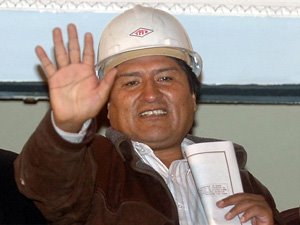
Evo Morales in the Words of Joseph Stiglitz


Evo Morales is considered one of the world's 100 Most Influential People by Time Magazine

When union organizer Evo Morales was elected President of Bolivia in 2005, it was the first time in the country's history that the indigenous people, who make up roughly 60% of the population, had one of their own as President. He moved quickly away from the neoliberal policies of his predecessors to try to help his community, the vast majority of whom live below the poverty line.

In a time of skyrocketing commodity prices, Morales, 48, earned the ire of the oil companies and the envy of other Presidents in the region by renegotiating outdated energy contracts to earn more money for the country's coffers — a portion of which he put toward increased health-care and social spending. He has resisted the temptations of his high position in favor of a low-key manner that includes an appreciation of simple food — a meat-and-potatoes man, he once took me for lunch at a local BBQ joint — and a taste for wearing his favorite old sweaters.

His government has been unable to accomplish much of what it set out to do. The bureaucrats have dug in their heels, and the country's élites hate his populist rhetoric and close ties to Venezuelan strongman Hugo Chávez. But Morales remains popular with his people. Although he will continue to find that delivering on his campaign promises is hard, his presence in the presidential palace will inspire indigenous people throughout Latin America.
***
Stiglitz is a Nobel laureate.
His latest book is The Three Trillion Dollar War .


Labels: ,

Wednesday, September 26, 2007

Evo in America

NEW YORK (digitalwarriormedia): Since arriving in New York City to attend the United Nations’ General Assembly, President Evo Morales has played soccer with Bolivian youths on Manhattan’s east side, addressed an historic gathering of world leaders on climate change and even made an appearance on one of America’s most popular satirical television programs – Jon Stewart’s Daily Show. All of this before his speech in front of the UN on Wednesday evening.


This is Morales’ second visit to the Big Apple and while speaking at Cooper Union on Monday night, he offered insight into the movement that elected an indigenous president and continues determined to transform Bolivia. His manner and insight often drew laughter and cheers of solidarity from the audience.

He shared anecdotes from his political beginnings as a coca farmer and labor leader in Cochabamba. Still - almost two years into his presidency - Morales continues to express a degree of suspended disbelief that a man of his humble means could be elected president.

He recalled an ancestral law of, “Don’t Steal, Don’t Lie, Don’t be Lazy” – an Incan concept even greater than common tenants of the nation’s Constitution. In keeping with this tradition, his days in the Presidential Palace often begin at 5 a.m.

One of Morales’ first decrees as president was to cut the salaries of all government officials in order to demonstrate a commitment to battling corruption.

He indicated a willingness to earn less than his monthly salary of 15,000 bolivianos, but Bolivian law prohibits government officials from receiving a higher salary than the President, and he can not ask his colleagues to work for less.

Often criticized in the international media for populist policies, Morales explained that by nationalizing the nation’s hydrocarbon sector, the government’s earnings rose from $300 million to $2 billion in less than 2 years.

He noted that Bolivia’s economy had experienced its first surplus since 1960 - all of this in a nation that is rich in natural resources but historically crippled by corruption.

And while Bolivia is still experiencing growing pains with unresolved structural problems, slow-moving state agencies and difficulties with justice ministers, Morales cautioned against believing news stories that sensationalize the events occurring in Bolivia.

Morales and the MAS party continue forward as opposition parties receive support from the U.S. government – an issue he says should be of concern to U.S. taxpayers who deserve to know where their tax money is being spent.

He also stated that the American public should expel ex-President Gonzalo Sánchez de Lozada, instead of allowing the U.S. government to offer a human rights violator safe haven.

In his most recent meeting with the U.S. Ambassador to Bolivia - where they discussed Iran, visas and mutual cooperation - Morales told Ambassador Goldberg that there must be transparency between the two nations before real cooperation can exist.

He continues his stance that even small countries have dignity and sovereignty and can decide with which countries they will seek diplomatic relations. As such, Morales will host Iran’s President Mahmoud Ahmadinejad in Bolivia on Thursday - where they will discuss bilateral cooperation - much to the consternation of the U.S. and other western nations.

Last year when Morales stood before the General Assembly, he displayed a coca leaf and called for the rights of indigenous people to their culture and traditions as he denounced the international policies that contaminate the environment and permit war.

This year he is expected to speak extensively about the environment and put forth a dialogue that examines the root causes of climate change - namely rapid capitalist development, over- consumption and the concentration of wealth.

And although the words of President Bush and President Ahmadinejad may be generating the most international press and attention, it is likely the words of an indigenous labor leader from a small, landlocked country in the Americas will offer the most food for thought and hope for a more equitable and prosperous future.

Jallalla!

Labels: ,

Saturday, December 23, 2006

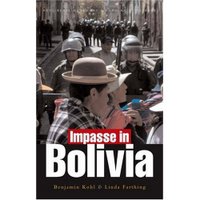
Impasse in Bolivia: Neoliberal Hegemony and Popular Resistance


Linda Farthing & Ben Kohl explore the tensions between markets, democracy, neoliberalism, state restructuring and citizenship. In this regard, the balance of citizen rights has been shifted away from providing citizens with social rights to privileging the property rights of private, mostly transnational, firms.

Bolivian Stalemate throws light on the reasons and processes behind the rising opposition in country after country in Latin America to the currently fashionable, internationally prescribed economic development strategy of neoliberalism.


Labels: ,

Saturday, October 07, 2006

bomba

Rival miners' groups agreed to a cease-fire after a day of clashes over access to one of South America's richest tin mines left at least nine people dead and 40 injured, a senior official said.
Hundreds of miners belonging to independent cooperatives, which backed President Evo Morales in last December's elections, stormed the state-owned Huanuni mine early Thursday to demand more access to its tin deposits. State-employed miners counterattacked to regain control, and the groups exchanged deadly volleys of gunfire and dynamite.

Public Defender Waldo Albarricin announced late Thursday that the two groups had agreed to cease hostilities so that both sides could bury their dead.

"The peace agreement comes at the will of workers on both sides," said Albarricin, adding that meetings between the camps will continue Friday morning to negotiate a more permanent agreement.

Bolivian state TV had originally announced 12 people had been killed, and even listed their names, but Vice President Alvaro Garcia Linera later said the official death toll was nine.

Among the dead were men and one woman from both sides, as well as a bus driver, according to media reports. "What should have been a blessing for the country, to possess such natural riches, today has become a curse," Garcia said in a national address.

A team of Bolivia's top ministers was dispatched to the mining town of Huanuni, 180 miles (290 kilometers) south of the capital of La Paz, to mediate an end to the conflict.

Angry miners criticized the government for declining to mobilize the military after the clashes began. Some accused Morales of withholding troops to avoid a confrontation with the mining cooperatives that played a key role in the populist movement that helped him win election.

"If they will not send the army, then they should send us boxes for our dead," said Pedro Montes, secretary-general of the Central Obrero Boliviano, a national union representing the state-employed miners.

Morales, an Aymara Indian, was elected in December with a mandate to help Bolivia's poor indigenous majority see a larger share of the revenues from the landlocked nation's extensive mineral and natural gas deposits.

The battle for Huanuni has roots going back at least 20 years. In 1985, state mining company Comibol shuttered mines throughout Bolivia after a collapse in the world metal market, laying off some 30,000 workers.

While many of Huanuni's unemployed miners sought work in other fields and other parts of the country, some remained, and as prices recovered they formed independent mining cooperatives to continue mining tin on their own.

Bolivia eventually granted the Huanuni mine concession to then-British-based Allied Deals. When the company, now based in the United States, declared its Bolivian operations bankrupt in 2005, the mine returned to Comibol, despite demands from the miners' cooperatives for some control over the valuable deposits.

The cooperatives strongly backed Morales' campaign last year, and the president has since granted them some concessions at Huanuni

Labels: ,

Monday, May 08, 2006

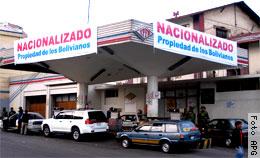
Bolivia Takes Control of Hydrocarbons


The plan was delayed but the promise was held. On May 1st, a symbolic day of labor struggle and 100 days after Evo Morales became president, Bolivia gained control of its natural gas and oil resources. Multinational companies have been granted 180 days to renegotiate their contracts with the government or face expulsion.

The decree signed by President Morales at the San Alberto field in Tarija province, states that Bolivia “recovers ownership, possession and total and absolute control" of hydrocarbons.

Morales sent armed troops and “battalions of engineers” from the state owned energy company Yacimientos Petroliferos Fiscales Bolivianos (YFPB) to the 56 oil fields and 2 refineries, ensuring no interruption of production and to deter potential saboteurs.

There are more than 20 companies with oil and gas interests in Bolivia. The major players are Brazil's Petrobras, the Spanish-Argentine company Repsol YPF, British companies British Gas and British Petroleum, France's Total, and the U.S. Exxon Mobil Corporation.

All energy sales are to be channeled through the Bolivian government, which will pay companies for their services. Previously, Bolivian law said the state no longer owned the gas once companies extracted it from under ground.

Some reports have indicated that companies could receive as much as 50% of profits from production. However during the transition period, that sum will be 18% of royalties – an amount that had previously been paid to Bolivia while multinationals kept the lion’s share of profits.

"The pillage of our natural resources by foreign companies is over," Morales declared.

Bolivian Vice President Alvaro Garcia said the government's energy-related revenue will jump to $780 million next year, an increase of almost 600% from 2002.

Bolivia’s decree immediately drew criticism from governments around the world. German Foreign Minister Frank-Walter Steinmeier warned that the move could have a serious impact on the Bolivian economy, affecting Bolivia's relationships with its Latin American neighbors, and its economic and trade relations with Europe.

Most heavily impacted are Spain’s Repsol and Brazil’s Petrobras. With investment over $2 billion, Petrobras is one of Bolivia’s largest foreign investors, owning 14% of the country’s gas reserves and controlling 95% of Bolivia’s refining capacity. Currently Brazil receives 50% of its natural gas from Bolivia.

The Brazilian Petrobras President Jose Sergio Gabrielli told Brazil's Globo Television Network: "There's no way that new investment in gas production with 18-percent return can be viable, these conditions make gas operations practically impossible in Bolivia."

Officially, companies are taking a “wait and see” approach, expressing a desire to work with the Bolivian government. However, some companies have inferred an intent to seek international arbitration to settle the matter.

Meanwhile Venezuela and Bolivia are forging stronger ties as President
Hugo Chavez and Morales created an alliance between YPFB and Venezuela’s state owned Petroleos de Venezuela (PDVSA), to develop projects that will include the industrialization of Bolivia's huge natural gas reserves.

Bolivia has the second largest reserves of natural gas in South America after Venezuela, estimated at more than 24 trillion cubic feet.

Labels: ,

Tuesday, April 25, 2006

Reforms and Resistance

Morales Confronts New Challenges
by Federico Fuentes
Originally published in Green Left Weekly, April 12, 2006.

Three months into Evo Morales' presidential term, much of Bolivia's mainstream media has been focusing on a range of protests and mobilisations by different sectors that have sprung up across the country.

The April 2 El Nuevo Dia commented that Morales was “getting a taste of his own medicine of blockades and mobilisations, as he became engulfed in a wave of protests”.

Mainstream media reports indicate that health workers, teachers and bus drivers have all pledged to go on strike, while indigenous communities in the south-east of the country blockaded roads for 24 hours to press for the creation of a 10th departmento (state).

The centre of most of the media's attention has focused on what has become Morales' biggest headache — the protest by pilots and other airline workers demanding the renationalisation of Lloyd Aereo Boliviano (LAB) airline. After occupying three airport runways, the protesting workers were removed by Bolivian police and soldiers using tear gas.

A New Wave of Protests?

According to Morales’ vice-president, Alvaro Garcia Linera, in comments he made to April 2 La Paz El Diario, “Bolivia is and will continue to be a site of mobilisations and protests by sectors which for decades have been abandoned in regards to legitimate demands”, but that it had to be taken into consideration that the big social movements that generated the uprisings in October 2003 and June 2005 — the neighbourhood committees of El Alto, cooperative miners, and the coca grower unions — are not the ones that are currently mobilising.

He added: “We are doing everything we can to collect these demands, but we should not exaggerate the level of social tension. It is worrying: the government would have preferred to not have these types of dispersed conflicts, but which can be resolved. We will gather these demands, but one thing is very clear, the business owners that have investments have to pay their taxes.”

Morales spokesperson Alex Contreras was reported by the April 3 El Potosi as saying that those workers who were demonstrating had no reason to do so as the government was willing to consider all their demands. However, he also explained that the government would not accept some of the demands, because “we all have rights, but we also have responsibilities to attend to”.

He made specific reference to the interdepartmental bus drivers, saying that their demand to not have to pay taxes “was not a just demand because there are some business owners who are the ones who do not want to pay taxes”.

LAB

The case of LAB perhaps best explains the complexities of the situation. Privatised in 1996, over 50% of the company was transferred into the hands of Brazilian company Viacao Aerea de Sao Paulo (VASP), which began to dismantle LAB including selling off the company’s spare parts and engine turbines.

Just under half of company’s shares are held in a trust, managed by foreign financial institutions, that cannot legally be touched by the Bolivian government. In 2001, Bolivian multi-millionaire Ernesto Asbun bought enough shares from VASP to take over LAB.

In February this year, most of LAB’s 2000 employees walked off the job, demanding back wages as well as payment of the airline's debt to the public pension system. The airline had more than US$160 million in debts. The government intervened in LAB, arresting Asbun on corruption charges.

On March 28, the Constitutional Tribunal (TC), upheld an appeal by Asbun, declaring the government intervention in LAB illegal. Two days later, judge Constancio Alcon decided that Asbun would be released on bail of less than $5000, despite pleas by the government for his preventive detention.

The next day, hundreds of striking LAB workers blocked runways airplanes, cars and mobile stairways, and other equipment, stopping flights from the cities of Cochabamba and Tarija.

According to a March 31 El Potosi report, Morales said he had “come to the conclusion that corruption is powerful in Bolivia”, and asked how much money the TC had received in order to ruke in favour of Asbun. “When I was detained for marching and mobilising my companeros for their demands, a judge gave me a fine of [around $7500] in order to be released from jail”.

Unable to legally move forward on this front, government officials entered negotiation with the LAB workers, stating the government’s position was that it would not “nationalise corruption” and burden the government with Asbun's debts and at the same time let him off the hook. Rather, they argued that Asbun should be punished for his crimes and that a new airline could be established under majority state ownership.

Initially, the LAB workers rejected the offer, with the ensuing clashes in the three occupied airports. As the conflict escalated, negotiations continued and by April 4 La Razon reported that, according to union general secretary Gustavo Vizcarra, the workers were no longer asking for nationalisation.

Associated Press reported on April 5 that Asbun agreed to the demand of LAB pilots and other employees that he resign and sell his stake in the airline.

Challenges Ahead

Even before the TC ruling on LAB, Morales, who was propelled to the presidency by his indigenous supporters through their “political instrument”, the Movement Toward Socialism (MAS), has already begun to come into conflict with the existing state institutions, specifically the judiciary.

In an interview with Paul Mason from the BBC, published online on April 5, Morales expressed his frustration on this issue: “You want to issue a decree to help the poor, the indigenous people, the popular movements, the workers... but there's another law. Another padlock. It's full of padlocks that mean you can't transform things from the palace... I feel like a prisoner of the neoliberal laws.”

There are two ways out of this dilemma for Morales — to back down back down in the face of opposition from the capitalist state bureaucracy and to start doing the bidding of its big-business masters, or to rely on the self-organisation of the working people to force through increasingly radical measures against those powerful interests.

The use of the police and military in the LAB dispute, although worrying, can hardly be seen as Morales having chosen the first option. The majority of the other protests have been met with dialogue and solutions, as the LAB case was in the end as well. The events have to be placed in the context of attempts by the right-wing to attack Morales by trying to portray the country as descending into chaos. By blockading airport runways, the LAB workers were potentially endangering the lives of other airline passengers.

Morales’ growing public support can be explained by his initial steps towards regaining control of Bolivia's gas industry, with the aim, according to Morales, of completing the nationalisation of Bolivia's hydrocarbon reserves by July 12.

Another important step was taken on March 4, when the parliament voted to move ahead with elections of delegates for the constituent assembly on July 2, as well as a referendum to grant greater autonomy to the country’s nine regional departments. According to a poll by Apoyo, Opini¢n y Mercado, 69% of Bolivian voters would vote “yes” in the referendum.

Another poll, carried out by Apoyo, Opini¢n y Mercado, in the period March 13-25, indicate that Morales' voter support is at 80%, more than 25 percentage points higher than the vote he received in last December’s presidential election. His support is even higher in the capital La Paz and in the nearby predominately indigenous city of El Alto — 82% and 86%, respectively.

Morales won the presidential election by building alliances among Bolivia’s diverse regional and sectoral social movements, attempting to unite them behind a national anti-imperialist project aimed at “decolonising” the white-dominated, racist Bolivian state. Central to this project is nationalising gas and a constituent assembly to refound the Bolivian state, this time with the participation of the indigenous majority.

As Morales pointed out to Mason: “In last year's election we only captured government — with the Constituent Assembly we want to capture political power.”

Labels: ,